
Joanna Robben’s Poolside Retreat Featured On 2026 Garden Tour
The upcoming DCMGA Garden Tour on May 9 will feature seven beautiful gardens, including the garden of Joanna Robben, as one of the stops on this year’s tour.
Finding the charming home of Joanna Robben (DCMG Class of 2025) on Mayflower Drive is very easy: you just look for the unmissable front façade of the house which is centered on a proud compound archway framing the front door. While many Tudor style homes in Dallas have arched entrances, this is perhaps the only one that can be affectionately referred to as “the house of seven arches” in the neighborhood.
The front yard of Joanna’s home is partially shaded by several trees that make a good environment for two Japanese Maples (Acer palmatum var. dissectum ‘Tamukeyama’), which sport fern-like leaves that give an impression of furry softness. Beneath a fine specimen of Texas Mountain Laurel (Dermatophyllum secundiflorum), which blooms with clusters of gorgeous purple pea-like flowers in spring, a bed of Japanese Holly Ferns (Cyrtomium falcatum) excels as a foundation planting.
Of particular note in the front yard is an exceptional 40-foot tall (!) Crape Myrtle tree anchoring the front right corner of the house. Don’t miss this rare specimen!
In some deeply shaded parts of Joanna’s lawn turf bare patches appear due to inadequate direct sunlight. This all too common problem has led her to experiment with alternative groundcover plants, notably Horseherb, a.k.a. Straggler Daisy (Calyptocarpus vialis), and Frogfruit (Phyla nodiflora), both of which are perennial or semi-perennial natives of Texas. Horseherb, in particular, has the very notable and rare characteristic of surviving and thriving in all possible sun exposures (full shade to part sun) while spreading both by runners and by self-seeding. In addition, Horseherb can be mowed, it can tolerate occasional light foot traffic, and it even produces pretty, tiny yellow flowers. This outstanding native plant is now being sold as a groundcover in some local retail nurseries, but it is actually commonly found growing as a weed in many Dallas lawns and flower beds and can be easily transplanted.

The back yard is built around a large rectangular swimming pool, which was the first pool ever constructed in the Stevens Park Estates neighborhood. Joanna enhanced it with the addition of new stonework at its head end and flagstone all around. Plantings all around the pool complement the scene for outdoor enjoyment.
A monumental Pecan tree once stood very close—too close—to the back wall of the house. Its branches spread in all directions, looming not only over the Robben residence but also extending over parts of the neighbors’ yards as well. In time, it became apparent that the danger of falling limbs—if not the whole tree—threatened everything beneath it, so five years ago the very big tree had to go.
Freed from the menacing prospect of falling Pecan limbs, Joanna’s formerly mostly shaded back yard was exposed to full afternoon sun from the west—an overnight extreme transformation of the growing environment. Not all of her plantings survived the transition from shade to sun, with some succumbing to the direct sun exposure, but others have weathered the change. In particular, two of the four Japanese Maple trees in the back yard now receive the afternoon sun, but Joanna says that they acclimated to the new conditions within a couple of years. She is experimenting with different plants to find those that can survive the radically changed microclimate.


The bed along the east side of the yard contains a mix of annuals and perennials whose blooms will peak in summer. Sulfur Cosmos flowers, with their cheery palate of hot oranges and yellows, self-seed readily and ensure reliable annual performance in the garden, so they will make their welcome appearance as usual. Old-fashioned Zinnias will also return annually from self-seeding. Meanwhile, the school bus-yellow blossoms of perennial Texas-native Zexmenia (Wedelia acapulcensis var. hispida) thrive in the harsh sun and heat reflected from the pavement.
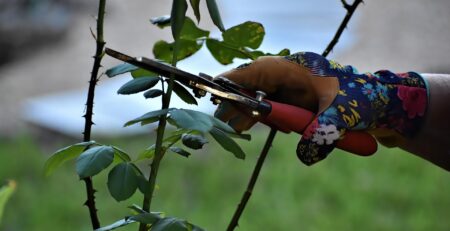
A special Rose grows in Joanna’s garden. It is an antique pink climber called ‘Peggy Martin,’ named for the Louisiana gardener who lost her parents, her home, and everything she owned in the devastation wrought by Hurricane Katrina in 2005. When she returned to her ruined homestead, which had been submerged by twenty feet of ocean water for two weeks, she spied a bit of green emerging from the frightful muck that had
engulfed her collection of 450 antique Roses. Of all of those, only this solitary glimmer of life remained. And so that Rose—until then of unknown origin and parentage, and now given the name ‘Peggy Martin’—became a symbol of hope and resilience.
Countless cuttings from that one resilient Rose and from its progeny have since been propagated and now grace many thousands of gardens across the United States. Joanna’s ‘Peggy Martin’ has been moved from one spot to the next as it sought its best “forever” place in her garden. But whatever the final destination, this unique Rose—with its promise of a future—brings beauty to every garden it graces.