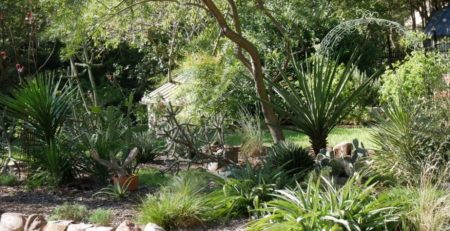

Lake Cliff Park Featured on 2026 Garden Tour
The Crape Myrtle (Lagerstroemia indica) is one of the most popular of all landscape plants in our North Texas region, and a demonstration garden featuring twenty-five varieties of Crape Myrtles is on public display in historic Lake Cliff Park in North Oak Cliff.
Lake Cliff Park had an early history dating back to 1888, when the artificial lake was excavated. From 1906 to 1913 large sections of the park functioned as an extremely popular amusement

park, including a 2500-seat performance venue, a dance hall, a Ferris wheel, a roller coaster, and a water slide, but this development’s success was short-lived. The loss of a bridge linking Dallas to Oak Cliff in the historic flood of the Trinity River in 1908 contributed largely to the decline of the early attractions at Lake Cliff. The developers who owned the land eventually sold it to the City of Dallas in 1913, following which it became the city park which it remains today.

A master plan for Lake Cliff Park was created in 1919 by George Kessler, the illustrious city planner and landscape architect whose visionary long-range planning left very significant and lasting effects on the fabric of the city of Dallas, as did his plans for many other American cities. The master plan called for the development of gardens on the northwest edge of the park along Zang Boulevard, which were eventually built. The first rose garden, planted by the Oak Cliff Society of Fine Arts, included an impressive 2000 rose bushes.
In 1934 the original rose garden was demolished for the creation of the current formal gardens. Signature pergolas and open-air pavilions were constructed of native sandstone at each end of the gardens by the WPA (Works Progress Administration), and still today they serve to define and distinguish the flower garden area of the park. According to the Friends of Oak Cliff Parks (FOCP), “The formal rose garden was reinvented in 1940-41 and extensive additional landscaping was completed by WPA workers.”
After many years of neglect, the FOCP restored the rose gardens in 2007-2008 to a planting plan of Earth-Kind® roses designed by Dallas County Master Gardeners. Dozens of new rose bushes were planted by the Dallas Parks and Recreation Department. Within weeks of the installation, approximately one third of them were stolen from the ground, but they were replaced relatively quickly.

At approximately the same time, the Dallas area had begun to become infected with the (so far) untreatable and incurable rose rosette virus, which gradually devastated most rose plantings throughout the whole region. Gardeners who had had roses in their gardens were forced to rethink what had always been an important part of their planting schemes. As afflicted rose plants were discovered in the Lake Cliff gardens, they were removed beginning in 2015, and by 2017 all of the roses had been pulled out. With the entire collection of roses absent from their

now empty beds, the idea for a replacement was born: a Crape Myrtle demonstration garden.
The Crape Myrtle Demonstration Garden project was inspired by the Crape Myrtle Trails of McKinney™ (https://crapemyrtletrails.org/) and was spearheaded by John Ellis (DCMG Class of 2015), who is a member of both the Dallas County Master Gardeners and the Friends of Oak Cliff Parks. Both organizations continue to lend their support to the effort and supply volunteers who participate in routine maintenance of the garden.
The 142 Crape Myrtles on display in the garden are arranged in same-variety groupings down the length of the parallel planting beds. The groupings are planted in mirrored symmetry as to flower color and plant height but not identically, as each grouping is unique. All plants (except for a few replacements) are mature, having been planted in 2017, so the various varieties can be compared not only for the colors of their blossoms but also for their relative sizes, which range from just over one foot up to eight feet. Thus, the demonstration garden enables visitors to observe first-hand a wide variety of cultivars that they may wish to select for their own gardens.

Like all demonstration gardens, the Lake Cliff Crape Myrtle garden serves to showcase one or more particular species of plants that are adapted (suited) for growing conditions in the geographic area in which they are planted. The specific purpose of such gardens is to demonstrate with real-life examples the various criteria which determine the adaptedness of plants to site-specific conditions. Chief among these are average rainfall, soil type (clay, loam, sand, etc.), soil pH
(acidic, neutral, alkaline, indifferent), soil moisture retention (well drained, water retentive, etc.), tolerance of climate extremes (USDA Plant Hardiness Zones and AHS Plant Heat Zones), and sun exposure at the planting site (full sun, part sun, part shade, full shade). Selecting plants whose horticultural requirements match the characteristics of the specific planting site is often described by the succinct phrase “right plant, right place,” which was coined by the influential British gardener Beth Chatto in her 1991 book The Dry Garden.
Sources:
Friends of Oak Cliff Parks, https://friendsofoakcliffparks.org/lake-cliff-park-1
The Cultural Landscape Foundation, https://www.tclf.org/landscapes/lake-cliff-park
Texas A&M University, https://aggie-horticulture.tamu.edu/earthkindroses/about/
Texas A&M AgriLife Extension, https://cdn-de.agrilife.org/extension/departments/plpm/plpm-pu-045/publications/files/rose-rosette-demystified-1.pdf
Wikipedia, https://en.wikipedia.org/wiki/George_Kessler