
Rybarski Garden Featured On 2026 Garden Tour
The upcoming DCMGA Garden Tour on May 9 will feature seven beautiful gardens, including the garden of Carol Rybarski, as one of the stops on this year’s tour.
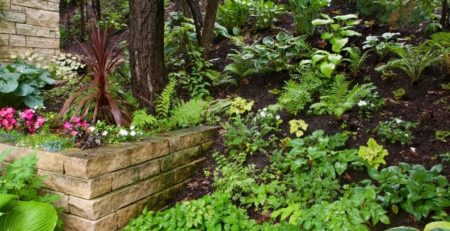
In the center of a block lined with grand homes stands an enormous landmark Texas Red Oak (Quercus buckleyi) tree that presides over the entire front yard of Master Gardener Carol Rybarski (DCMG Class of 2017). This unusual yard announces a distinctive house unlike any other on the block and immediately stands out from the carefully clipped lawns of all others by its unique naturalistic landscaping.
Former owners of this property were responsible for transforming this house and yard into a vision of the Texas Hill Country transplanted to Dallas. A significant fire in the house in 2006 left it in need of major restoration, and the buyers of the damaged house had a clear inspiration for what they could do with it. They “country-fied” the circa 1938 Texas Vernacular architecture of the house by introducing elements of native stone into its brick exterior during the remodel. And equally importantly, they created a rather convincing Hill Country landscape in this Oak Cliff yard by selecting plants that are endemic to that region.


Ten years later, in 2016 along came Carol and her husband Joseph, who had a love-at-first-sight encounter with this property when it was shown to them by their real estate agent. They found it to be the perfect marriage of house-plus-yard, and they ended up buying the home because of this very successful synthesis of architecture and landscaping.
Having started with an established landscape that already contained many excellent and well established plants, Carol’s fundamental contribution to this garden consisted of the insight that while the “transplanted Hill Country” concept was worthy, it was not exactly on point. Specifically, she realized that while Oak Cliff may be at the extreme north end of the Hill Country escarpment, the clay soils of the Texas Blackland Prairie in Dallas County are in fact completely different from the rocky limestone soils of the Edwards Plateau.This realization led Carol to re-evaluate the plant palette that had been chosen by the previous owners. She concluded that, while many of those plants were
appropriate for Dallas, some others were not. And so she set about purging her yard of those plants which she deemed inappropriate due to their lack of adaptedness or certain other characteristics. Along with the removal of a non-cold-hardy Agave, for example, she also chose to soften the landscape by removing all of the “poke-y” plants (i.e., those with dangerously sharp spines and thorns) from the yard in order to make it completely visitor- and neighborhood-friendly.
Carol has also chosen plants that are intentionally inviting to pollinators and, secondarily, to human visitors. For example, first to greet both insects and people at the street are stands of Gregg’s Blue Mistflower (Conoclinium greggii) on both sides of the sidewalk. This hardy Texas native groundcover blooms in abundance from spring to fall with fringey sky-blue flowers in small clusters, and in the fall it is an absolute butterfly magnet that attracts multitudes of butterflies, especially migrating Monarchs (Danaus plexippus) and their close relatives, the Queens (D. gilippus). In turn the butterflies attract passersby, who gather around to experience this close encounter with nature.
The plant list (i.e., inventory) of over forty species in Carol’s garden reads like a guidebook on native and adapted plants for North Texas. An excellent specimen of Texas Mountain Laurel (Dermatophyllum secundiflorum), a small evergreen tree that blooms with gorgeous Wisteria-like flowers in spring, takes pride of place in the center of the back yard. Nearby, a large Cenizo, a.k.a. Texas Sage, (Leucophyllum

frutescens) bush stands ready to bloom in lilac blossoms on the silver-gray leaves after a rain, as this plant often does. Native Coral Honeysuckle (Lonicera sempervirens) and ‘Texas Gold’ Columbine (Aquilegia chrysantha hinckleyana) bring warm colors into the garden, while the waving stems of Lindheimer Muhly Grass (Muhlenbergia lindheimeri) and Pink Gulf Muhly (Muhlenbergia capillaris) dramatically punctuate the scene with their big grassy tufts.
Apart from a relatively small area in the back yard planted with native Buffalograss (Bouteloua dactyloides) and overseeded with Thunder Turf (a mix of Buffalograss, Blue Grama, and Curly Mesquite short-grass prairie species), the entire front and back yards are devoid of any semblance of a conventional residential lawn. What’s more, due to her smart selection of Water-Wise plants, Carol rarely needs to water the yard at all.
Carol’s enthusiasm for her garden is evident from her first words when you have the opportunity to engage her in conversation about it. Having rid her yard of plants that “don’t belong in Oak Cliff, Dallas,” she is proud to characterize it as “a yard that looks like North Texas is supposed to look!”
Curious? Come and see; come and learn!