
Hammett Garden Featured On 2026 Garden Tour
The upcoming DCMGA Garden Tour on May 9 will feature seven beautiful gardens, including the garden of Hank Hammett, as one of the stops on this year’s tour.
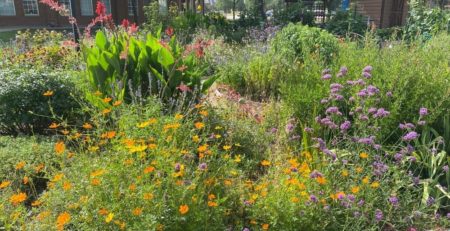
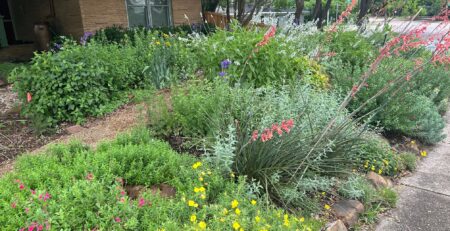
Undoubtedly the most distinctive feature of the house and garden of Master Gardener Hank Hammett (DCMG Class of 2024) is the spectacular view of Lake Cliff, directly across the street in Lake Cliff Park. But turning from the view of the lake, visitors discover the real appeal of this home by following a serpentine pathway, original to the house, which winds its way from the street lazily towards the front porch through naturalistic plantings of perennials. Behind a soft screen of shrubs lies the charming abode built in 1923.
When Hank and his husband Dale Dietert bought this house in 2009, he says that the property hardly had what could properly be called a yard: a few trees, shrubs, and some random Cannas and Mexican Petunias passed for plantings, but the undeniable effect was of complete neglect and indifference to the appearance of the yard. However, through years of hard work the pair have since generously furnished this quarter-acre yard with beautiful plants throughout, creating the friendly garden that is now their pride and joy.

They made the beginnings of a landscaped yard little by little, beginning with the back yard, which was anchored by a very large and very old Trumpet Vine (Campsis radicans). Over time, the vine had grown wild and huge and was overwhelming both the old wooden pergola on which it was growing and the deck surrounding it. For their very first garden project, Hank and Dale cut the vine back radically, removed the deck, and replaced it with a flagstone patio which they laid themselves. This patio now forms the central focal point of the back yard and functions as the principal area for outdoor living. In fact, they say that the living space of the yard saved their sanity during the pandemic of 2020.
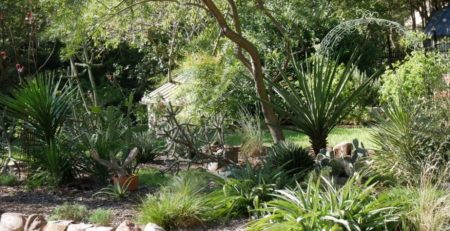
The back yard is now graced with informal planting beds arranged successively from the front to the back of the back yard. While the garden is structured, the effect is of a somewhat wild and natural landscape. A low dry stacked stone wall, constructed from leftover fragments from the flagstone patio project, supports
a Holly hedge which abuts the guest house and forms the backdrop of the whole scene. Native Virginia Creeper (Parthenocissus quinquefolia) vines climb on much of the iron fence forming the perimeter of the yard, and they create a lush green cocoon providing natural privacy screening.
In this garden gracefully uncluttered by excessive ornaments and accessories, two tasteful birdbaths are nestled within planting beds. Near the center of the garden stands the first: a vintage concrete birdbath on a fluted central column, which was left behind by previous owners of the house. A second birdbath rises from a groundcover bed in the side yard. It was hand carved of volcanic stone in Mexico and acquired by Hank and Dale on a trip to Laredo.
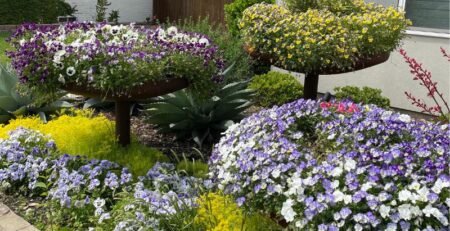
A purple and pink color scheme predominates in much of this garden. Half a dozen varieties of Ajuga flourish as groundcovers and bring rich purples to the garden floor, while deep purple shamrock-like leaves of low-growing Oxalis triangularis punctuate the borders. A collection of more than a dozen cultivars of Coral Bells (Heuchera) includes some shades of purple leaves (‘Plum Pudding’ and ‘Northern Exposure Purple’). The foliage of a loose hedge of Chinese Fringe Flower (Loropetalum chinense) along the front of the house and borders of compact Nandina ‘Flirt’ in the back yard show off purple-red leaves. Purple and lilac flowers feature on Obedient Plant (Physostegia virginiana), Bee Balm (Monarda spp.), and several different Salvias (‘Plum Purple Anise Sage,’ ‘Plum Crazy,’ and ‘Vibe Ignition Purple’), all of which genera are native to Texas.
Pink, in shades from pale to passionate, is a dominant color among flowering annuals such as Cosmos and especially among blooming perennials such as Turk’s Cap (Malvaviscus arboreus), Texas Rock Rose (Pavonia lasiopetala), and Mexican Petunia (Ruellia simplex), which are also all native or naturalized in Texas. The garden also has half a dozen cultivars of Crape Myrtle (Lagerstroemia indica) that flower in various shades of both pink and purple, as well as white.
This intentionally low-maintenance woodland garden has soft lines throughout and not a whiff of symmetry nor formality, which easily explains its peaceful and cozy vibe. When you meet the gardener-owners, you will immediately sense how this comfortable and appealing space bespeaks their easygoing personalities. Come to experience the relaxed welcome of this garden that feels like a visit to the home of your favorite uncle.