
The Grove: From Bermudagrass to Pollinator Paradise
Most garden stories begin with a backyard. Ours began in the street.
When my husband Mark and I finally found the ideal building site, we were too busy dreaming about floor plans and paint colors to pay much attention to the 450-foot triangular median in front of our future home. It was simply…there. A patch of Bermudagrass, a tangle of invasive trees, and a convenient shortcut for hurried drivers carving U-turns through the mud.
Years later – as freshly minted Dallas County Master Gardeners – we began to see it differently. What once looked like a nuisance started to look like an opportunity. A blank canvas. A place waiting for someone to care.


And that’s when the story began of the median we affectionately named, “The Grove.”
A Forester, a Few Seedlings, and a Vision
When Mark joined the Citizen Forester program, he shared the median’s plight with his instructor, Dallas City Forester, Karen Woodard. She arrived with her trademark expertise and a roll of yellow ribbon, quickly identifying the invasive trees and directing the Parks Department to remove them.
She also identified a critical design constraint: because of the swale (a shallow trough-like depression in the median that manages water flow), any new trees would need to survive both long stretches of drought and Dallas’ famous spring deluges.
Thanks to Dallas Water Utilities Branch Out Dallas, we secured the tree varieties Karen recommended – chinkapin oak, burr oak, cedar elm, and Autumn Blaze maple – seedlings all free of charge. Over the next three years, Mark planted twenty‑five trees and faithfully tended them through blistering summers.
Slowly, the median began to change.
Discovering “MOWmentum”
Once the young trees became established, we turned our attention to the 110-foot stretch directly in front of our property. Using the organic, science-based methods we learned during Master Gardener training, Mark scalped the area and layered large pieces of cardboard alternating with grass clippings and shredded leaves in a classic “lasagna” method. It smothered the Bermudagrass while enriching the soil and suppressing weeds.
Then COVID arrived and, like everyone else, we found ourselves homebound with extra time and an unexpected desire to create something beautiful.
That’s when we discovered the City of Dallas MOWmentum Program, a partnership between the city and residents to beautify public rights-of-way. We submitted a rough plan for a drought-tolerant pollinator garden, met with city staff, and signed a five-year agreement granting us permission to maintain the space.
Just like that, our median had a name, a purpose, and a future.

Creating a Garden on a Zero‑dollar Budget
Master Gardeners are nothing if not resourceful. When we reached out to fellow MGs, they responded with seemingly boundless generosity: divisions, seedlings, extra perennials, and “I have one more if you want it” treasures. Neighbors joined in too, offering boulders, stepping stones, irises, a bench, and even sections of storm-damaged trees that now serve as rustic seating.
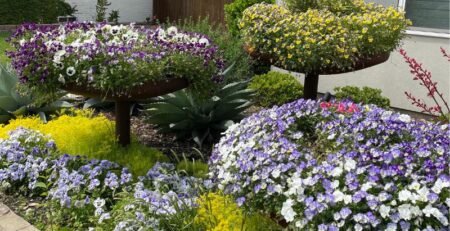
Piece by piece, The Grove grew into a thriving pollinator paradise filled with Texas Superstars® and hardy natives – Turk’s cap, rock rose, frostweed, lantana, Mexican plum, prairie crabapple, bee balm, flame acanthus, hesperaloe (commonly called red yucca), black and blue salvia – and sprinkled with wildflowers, zinnias, cosmos, and more.
Every plant was donated. Every bloom was a gift. And the pollinators – bees, butterflies, hummingbirds – arrived right on schedule.


How to Start Your Own MOWmentum Project
- Identify a space that needs love. Look for medians, parkways, or rights-of-way that are neglected or underused.
- Contact the MOWmentum program. Review requirements and request a site visit. City of Dallas MOWmentum program: https://dallascityhall.com/departments/public-works/Pages/MOWmentum.aspx
- Create a science-based, sustainable plan. Choose drought-tolerant, visibility-safe plants. Consider soil, drainage, and long‑term maintenance.
- Gather materials – creatively. Ask neighbors, fellow MGs, and local projects for extra plants, stones, mulch, or seating.
- Prepare the site. Use organic methods like sheet mulching (“lasagna gardening”) to suppress weeds and build soil.
- Plant, water, and celebrate. Install your plants, water deeply, and enjoy watching pollinators discover their new home.
- Maintain and share the space. Weed, mulch, water young plants, and engage neighbors. A cared‑for space inspires more care.
Texas Superstar® Plants Featured in The Grove
Texas A&M AgriLife and its partners have identified over 90 Texas Superstar® plants. The full list is available at https://texassuperstar.com/. These proven performers thrive in North Texas heat, clay soils, and drought cycles. We included the following in our plantings at The Grove:
- Turk’s Cap (Malvaviscus arboreus var. drummondii): Shade tolerant, hummingbird magnet, blooms all summer.
- Flame Acanthus (Anisacanthus quadrifidus var. wrightii): Heat loving, drought proof, adored by butterflies.
- Rock Rose (Pavonia lasiopetala): Tough, pink‑flowered perennial that thrives in poor soil.
- Lantana (Lantana urticoides): Colorful, long blooming, and beloved by pollinators.
- Black and Blue Salvia (Salvia guaranitica): Hardy, vigorous, and blooms from early spring to first frost.
A Closing Reflection
Today, The Grove is more than a garden; it’s a reminder of what can happen when people choose to notice the overlooked public spaces and care for them. What began as a patch of neglected ground has become a place where neighbors pause, children explore, and pollinators thrive.
It has taught us that beauty doesn’t always require a budget – just intention, patience, and a willingness to begin. And if a single median can become a neighborhood treasure, imagine what other small spaces in our city might become with a little MOWmentum of their own.

Photos by Johan Salvador Tavares DCMG
Author Bio
Cynthia Jones has always loved plants, but her busy schedule as an anesthesiologist, wife, and mother left little time for gardening. After retiring, her daughter encouraged her to complete the Master Gardener program, whose mission to educate others on best horticultural practices soon became a family passion. Today the Joneses are the only family in Dallas County with three Master Gardeners: Cynthia, her husband Mark, and their daughter Nicole. Mark is her steady partner in every project, working with students at Lakewood Elementary School where Nicole teaches first grade, growing vegetables for the underserved at Raincatcher’s Garden, and their shared labor of love, The Grove, which would never have been possible without his constant support, creativity, and inspiration.